Where the Divide Comes From
The terms "literary fiction" and "genre fiction" weren't handed down from some neutral authority. They emerged gradually through the intertwined histories of publishing, academia, and taste-making institutions - and they've carried a quiet hierarchy ever since. Literary fiction came to mean serious, artistically ambitious work aimed at readers willing to linger. Genre fiction meant popular categories - mystery, romance, science fiction, fantasy, horror - organized around recognizable conventions and reliable audience expectations.
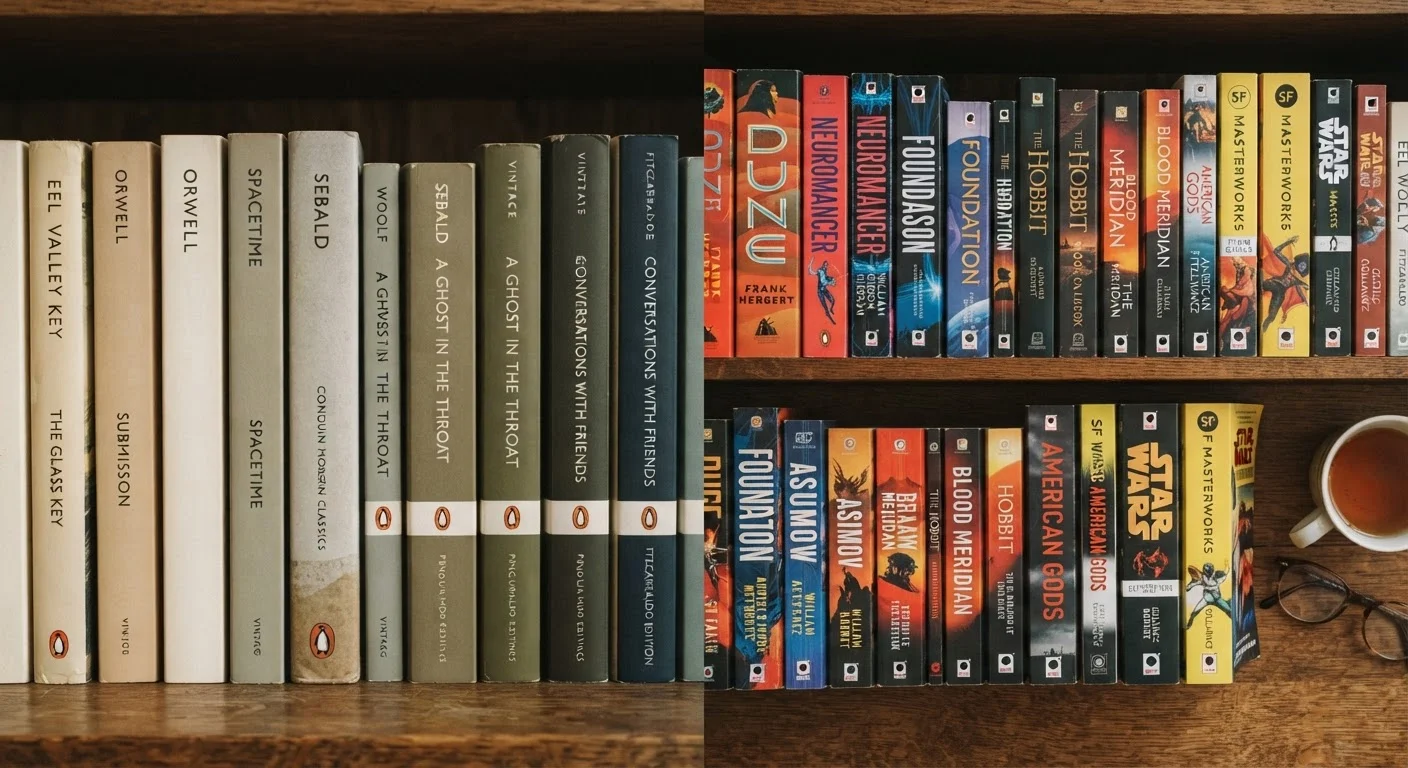
The distinction crystallized most sharply in the 20th century, when university English departments began selecting a canon of approved texts and prize committees started rewarding particular kinds of prose. Genre fiction was largely left outside those walls. As the debate over genre fiction's cultural status shows, that exclusion has had real consequences for which stories get taken seriously - and which authors build sustainable careers.
But the line was always porous. Mary Shelley's Frankenstein is both foundational science fiction and a canonical literary text. Raymond Chandler's hard-boiled mysteries are studied in literature courses. The division is more social than structural: it reflects who gets reviewed in certain publications, who wins certain awards, and which paperbacks get shelved in which section of the store.
How Each Approach Actually Works
Strip away the prestige question and the two modes do have genuine, describable differences - though they operate on a spectrum, not a strict binary.
Literary fiction tends to center interiority: the texture of consciousness, the slow accumulation of emotional truth, sentences crafted to do double duty as both meaning and music. Plot exists, but it's often subordinate to character revelation or thematic exploration. Endings may resist resolution deliberately, reflecting the author's belief that ambiguity is truer to human experience.
Genre fiction is structured around reader contract. A thriller promises escalating tension and a resolution. A romance promises an emotionally satisfying relationship arc. A mystery promises a puzzle and its solution. Shared genre conventions aren't limitations - they're the foundation of reader trust, and skilled genre writers work brilliantly within and against those expectations.
| Criterion | Literary Fiction | Genre Fiction |
|---|---|---|
| Primary emphasis | Language, interiority, theme | Plot, convention, reader expectation |
| Narrative resolution | Often ambiguous or open-ended | Usually resolved and satisfying |
| Prose style | Frequently foregrounded as art | Functional to invisible; varies widely |
| Prize recognition | Historically dominant in major awards | Mostly separate award ecosystems |
| Reader contract | Loose; rewards patience and re-reading | Explicit; genre signals set expectations |
| Category stability | Defined by critical consensus | Defined by marketable genre conventions |
Neither approach is inherently superior. They're solving different problems for different reading moods. And increasingly, the most interesting books refuse to choose. Cormac McCarthy's The Road is post-apocalyptic science fiction. Kazuo Ishiguro's Never Let Me Go is a dystopian novel. Both are taught in literature courses without apology.
Why the Line Keeps Moving
What counts as literary fiction has always been a moving target - shaped by taste, era, and who holds institutional power. A generation ago, crime fiction by authors like Elmore Leonard or Patricia Highsmith was widely dismissed as pulp. Today, literary critics regularly celebrate writers in the same tradition as artists working at the highest level.
Publishing economics play a role too. As the forces reshaping literary categories make clear, commercial pressure and cultural shifts constantly redraw genre boundaries. Publishers have discovered that genre fiction with literary sensibility sells - sometimes to different audiences simultaneously. A book can land on a romance bestseller list and receive a starred review in a literary journal. Those outcomes used to feel mutually exclusive.
Hybrid genres have accelerated this blurring. Genre-blending fiction - literary horror, speculative memoir, climate thriller - has made the either/or framing feel increasingly outdated. Readers are the net beneficiaries: there's simply more to choose from, at higher average quality, across every shelf in the store.
For readers trying to find books that match their tastes, the practical takeaway is this: use the literary/genre distinction as a rough signal about emphasis, not as a judgment about worth. If you want gorgeous sentences and unresolved endings, lean literary. If you want momentum and payoff, lean genre. And if you want both, know that the books delivering exactly that have never been easier to find.