
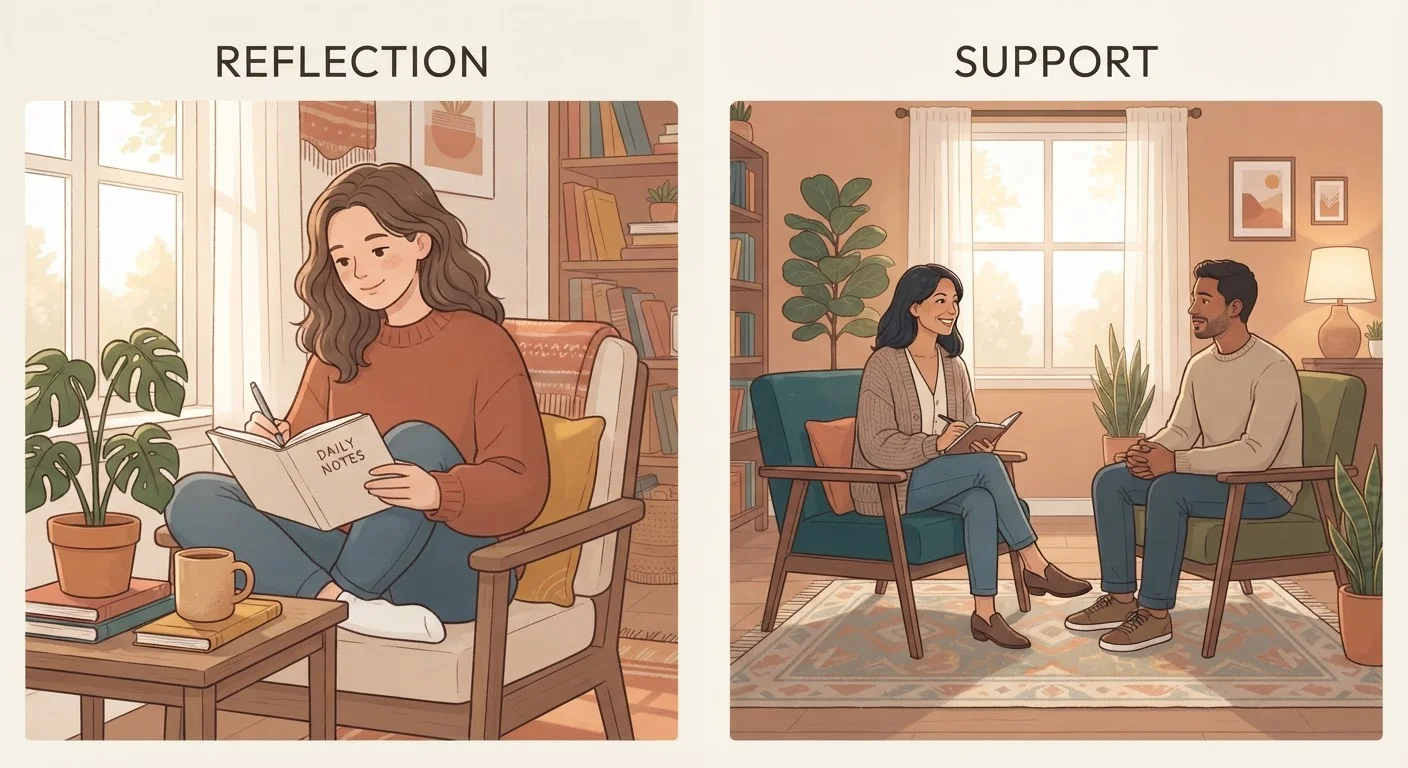
Defining the Two: What Each Term Actually Means
The phrase "self-care" has been stretched so wide that it risks losing meaning - but at its clinical core, it refers to intentional behaviors a person adopts to maintain their physical, emotional, and social health. Think: consistent sleep hygiene, regular physical activity, social connection, mindfulness practices, and setting healthy limits on stress. These are habits, not interventions.
Mental health treatment, by contrast, is structured clinical care delivered by licensed professionals - psychologists, licensed clinical social workers, psychiatrists, counselors, and others - using approaches validated by research. It includes psychotherapy modalities such as cognitive behavioral therapy (CBT), medication management, diagnostic assessment, and coordinated care plans. For a deeper look at the distinctions between types of providers, see our guide to therapy, counseling, and psychiatry.
Understanding what these terms mean - separately - is the first step to using both effectively. The confusion between them is not just semantic; it has real consequences for people who need one but are relying on the other.
Where Self-Care Genuinely Helps
Self-care is not a wellness industry invention - it has legitimate grounding in behavioral science. Practices like aerobic exercise have been associated with reductions in depressive symptoms in multiple studies. Sleep quality has direct bidirectional links to mood regulation and cognitive function. Social connection is one of the most robust protective factors in mental health research.
These aren't minor effects. For people experiencing mild stress, life transitions, or the ordinary friction of daily pressures, consistent self-care can meaningfully stabilize mood and reduce vulnerability to more serious episodes. Small daily habits that support mood stability are a realistic and evidence-aligned place to start.
| Criterion | Self-Care | Mental Health Treatment |
|---|---|---|
| Who delivers it | The individual themselves | Licensed mental health professionals |
| Primary purpose | Maintain and build emotional resilience | Diagnose and treat mental health conditions |
| Evidence base | Behavioral science support for habits | Validated clinical protocols and trials |
| Appropriate for | Mild stress, maintenance, prevention | Diagnosable conditions, significant impairment |
| Can it diagnose conditions? | No | Yes, through clinical assessment |
| Works best when | Used consistently as a baseline habit | Tailored to individual clinical presentation |
| Role in a care plan | Supportive adjunct to treatment | Core clinical intervention |
Self-care also plays a documented supportive role within treatment - people who maintain healthy routines during a course of therapy often show better outcomes than those who don't. But that's the key phrase: within treatment, not instead of it.
Where Self-Care Falls Short - and Why That Matters
The most consequential misunderstanding is treating self-care as an equivalent substitute for professional mental health care. It isn't - and the gap between them becomes dangerous when symptoms are clinical in nature.
Conditions such as major depressive disorder, generalized anxiety disorder, bipolar disorder, post-traumatic stress disorder, and others involve biological, psychological, and sometimes neurological components that require professional assessment and targeted intervention. No amount of journaling or yoga can reroute pathological thought patterns with the precision of structured CBT, nor can a healthy diet replace medication that may be medically indicated for a given condition.
This distinction is partly obscured by stigma. When mental health struggles are framed as character weaknesses or problems solvable through willpower and habit, people are implicitly pushed toward self-management. Persistent myths about mental health actively discourage people from seeking appropriate care - sometimes with serious consequences. If symptoms are persistent, worsening, or significantly interfering with daily functioning, that is the signal to contact a qualified provider, not to double down on self-care strategies.
Not Sure Which You Need?
A useful starting point is duration and impairment. If feelings of sadness, anxiety, or overwhelm have lasted more than two weeks and are affecting your ability to work, sleep, or maintain relationships, that warrants a conversation with a healthcare provider - not just a new habit. Many primary care physicians can offer an initial mental health screening and referral. You don't need certainty about a diagnosis to reach out. For help understanding common mental health terminology before that conversation, see our plain-language mental health glossary.
This article is for informational and educational purposes only. It is not a substitute for professional medical or mental health advice, diagnosis, or treatment. If you are experiencing a mental health crisis or persistent symptoms, please consult a qualified healthcare professional.