
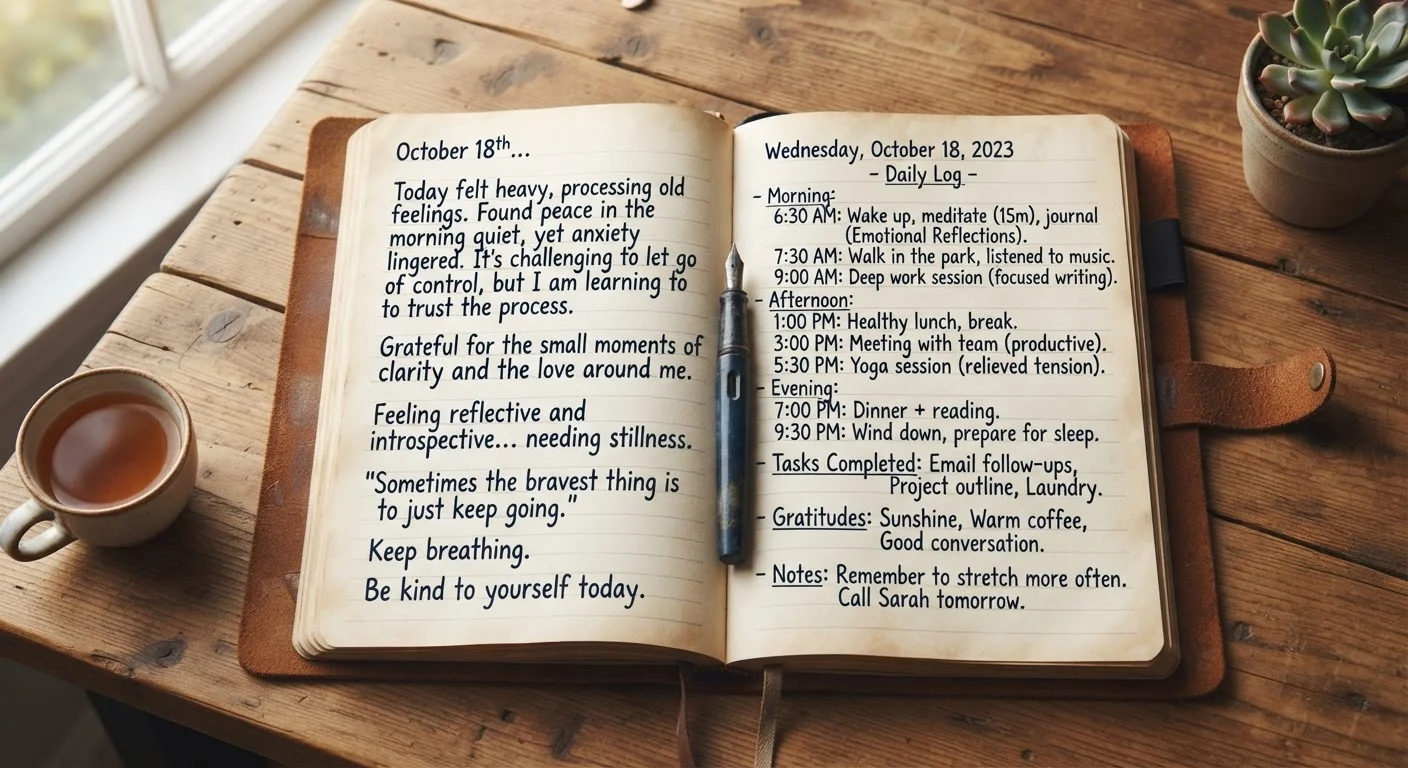
What Sets These Two Approaches Apart
The word "journaling" covers a wide range of practices. At one end sits emotional processing journaling - an inward, exploratory form of writing aimed at understanding feelings, unpacking difficult experiences, and building self-awareness. At the other sits the daily log - a factual, structured record of what happened: tasks completed, food eaten, miles run, meetings attended.
These two forms share a medium - pen and paper, or screen - but serve fundamentally different functions. Emotional processing writing asks what am I feeling, and why? Daily logging asks what did I do, and when? Understanding that distinction helps you use each tool more intentionally. For a grounded primer on how emotions work before you begin writing about them, see this introduction to emotional awareness.
| Criterion | Emotional Processing Journaling | Daily Log Journaling |
|---|---|---|
| Primary focus | Internal feelings and experiences | External events and behaviors |
| Core question | What am I feeling, and why? | What did I do, and when? |
| Writing style | Exploratory, narrative, open-ended | Factual, structured, concise |
| Evidence base | Linked to reduced psychological distress | Supports habit tracking and accountability |
| Emotional vulnerability required | High - disclosure is the point | Low - facts, not feelings |
| Best timing | During or after emotional difficulty | Daily, as a consistent routine |
| Practical applications | Self-awareness, emotional regulation | Habit formation, pattern recognition, records |
The Evidence Behind Emotional Processing Writing
Decades of psychological research - much of it building on the pioneering work of social psychologist James Pennebaker - have examined what happens when people write about emotionally significant experiences. Studies consistently find that structured expressive writing is associated with reductions in psychological distress, improved mood, and in some cases better physical health indicators, though effect sizes vary across populations and study designs.
The proposed mechanism is emotional disclosure and cognitive processing: putting feelings into words forces the brain to organize fragmented emotional memories into coherent narratives, which can reduce their disruptive power. This is not therapy, and writing alone is not a substitute for professional mental health support. But as a supplementary self-care practice, reflective journaling has meaningful evidence behind it.
Importantly, how you write matters. Writing that only vents without any attempt at reflection or meaning-making may not produce the same benefits as writing that tries to understand or contextualize an experience. Prompts like "What did this situation teach me?" or "What emotions came up, and what might they be telling me?" tend to support deeper processing. This kind of journaling pairs well with other small daily habits that support mood stability.
What Daily Logging Does Well
A daily log operates differently - and does different things well. Rather than exploring the inner world, it captures the outer one: what you ate, how you slept, whether you exercised, what appointments you kept. This kind of tracking builds behavioral accountability and makes invisible patterns visible over time.
Because log entries are relatively factual and low-stakes emotionally, they're easier for many people to sustain as a daily habit. There's no vulnerability required to write "walked 20 minutes, slept 7 hours, felt tired by 3 p.m." That lower barrier makes logs particularly useful for habit formation and for creating a reliable external memory system.
Daily logs also have practical applications beyond personal wellbeing. A consistent factual record can be valuable in professional contexts - for instance, documenting workplace issues clearly requires the precision and timestamping a log provides, not the impressionistic tone of emotional writing.
15-20 min
Writing duration in Pennebaker expressive writing studies
Research by psychologist James Pennebaker typically used sessions of 15-20 minutes over three to four consecutive days to observe measurable psychological benefits.
~66 days
Average time to form a new habit through repetition
A study published in the European Journal of Social Psychology found that habit automaticity took an average of 66 days to develop, underlining the value of consistent daily logging for behavioral change.
Choosing One, or Combining Both
These two journaling styles are not mutually exclusive. Many people maintain a brief daily log alongside occasional emotional processing entries - written when something significant happens or when feelings are hard to shake. Others use a single journal but shift intentionally between modes: logging in the morning, reflecting emotionally in the evening.
The right approach depends on what you need right now. If you're in a period of emotional difficulty - processing a loss, managing anxiety, or navigating a major change - reflective writing is likely the more supportive tool. For those in a relatively stable period who simply want more visibility into their habits and routines, a structured log may be more practical and sustainable.
If journaling surfaces persistent or intense emotional distress, that's a signal to involve a qualified mental health professional rather than writing through it alone. Journaling can be a powerful complement to therapy, but it is not a replacement. For moments when emotions spike suddenly and feel overwhelming, grounding techniques can help re-anchor you before you sit down to write.
This article is for informational purposes only and does not constitute medical or psychological advice. If you are experiencing significant emotional distress, please consult a qualified mental health professional.